
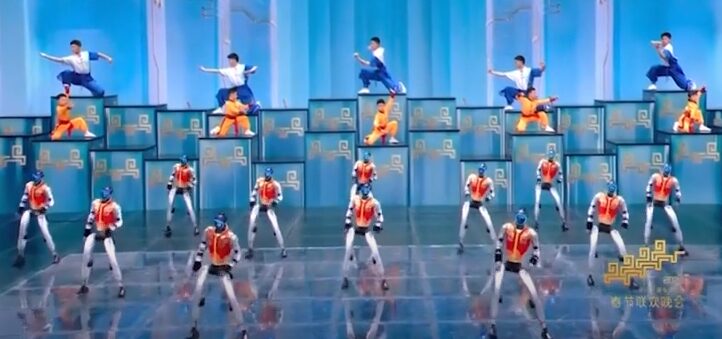
China’s annual Spring Festival Gala featured an eye-catching performance this year, with dancing humanoid kung fu robots taking the spotlight. The robots lunged, spun, backflipped, and even performed kung fu routines without falling. The show highlighted how far Chinese robotics companies have advanced, especially in developing what many online viewers quickly dubbed “kung fu robots.”
These kung fu robots were designed by several Chinese robotics firms and performed alongside human dancers. Compared to last year’s lunar new year broadcast, where robot movements were simpler—mostly walking, twisting, and basic kicks—this year’s machines showed more complex coordination and balance. Online clips of the performance spread quickly, drawing attention both inside and outside China.
Some experts believe the display was more than entertainment. Kyle Chan, a researcher at the Brookings Institution in Washington DC, said China uses these public performances to showcase its technological progress. According to Chan, humanoid robots are highly visible examples of innovation. Unlike AI software or industrial machinery, kung fu robots are easy for general audiences to understand and admire when they see them on television or social media.
Chan also pointed out that while China and the United States remain close competitors in artificial intelligence, China may currently have an edge in scaling up humanoid robot production. Public events like the gala help reinforce that perception.
Georg Stieler, head of robotics and automation at Stieler Technology and Marketing, emphasized that the Spring Festival Gala is unique because it directly connects industrial policy with a prime-time spectacle. He noted that this year’s performance demonstrated improved synchronization among large numbers of nearly identical robots. The machines moved with stable gaits and consistent joint control, which signals technical progress.
However, Stieler cautioned that stage performances do not necessarily reflect industrial reliability. He explained that the robots likely practiced the same routine hundreds or thousands of times. They were not improvising or responding dynamically to changing conditions. The choreography relied heavily on imitation learning and balance control rather than advanced environmental awareness. This means the kung fu robots may not yet be ready for unpredictable factory environments, where adaptability and dexterity are essential.
The showcase fits into China’s broader technological ambitions. By the end of 2024, the country had registered more than 451,000 smart robotics companies, with total capital reaching 6.44 trillion yuan (about $932 billion), according to official data. Major national strategies such as Made in China 2025 and the 14th Five-Year Plan have prioritized robotics and artificial intelligence as key development areas.
Financial forecasts also reflect growing momentum. Morgan Stanley projects that China’s humanoid robot sales will more than double to 28,000 units by 2026. At the same time, Elon Musk has stated that he views Chinese companies as major competitors as Tesla shifts toward embodied AI and its humanoid robot, Optimus.
According to Marina Zhang, a technology professor at the University of Technology Sydney, the highly visible performance of kung fu robots signals a broader transformation. She suggests that robotics will play a central role in China’s shift from low-cost manufacturing to advanced, intelligent production systems.
Overall, while the gala performance demonstrated impressive choreography and coordination, experts agree that entertainment value should not be confused with full industrial readiness. Even so, the rise of kung fu robots reflects China’s growing influence in the global robotics industry.